COURSES
Academic Program Offerings
A 2-course sequence, counting for AUCC credits, that introduces students to the complexity of Humanities-based thinking, and investigating the way such thinking can enter into STEM concerns.
- IU174A-D: Questions for Human Flourishing
- IU173A-D: Thinking Toward a Thriving Planet
A certificate in interdisciplinary learning that includes IU173 and IU174 along with 9 additional upper-division courses in the CLA that further the vision of the Arts & Humanities and the STEM fields as necessary partners
IU174A-D
Questions for Human Flourishing
We call Questions for Human Flourishing our “Gold” course—color of ripe wheat and the nourishing grain, precious metal that keeps its luster across millennia. These classes approach concerns that have been our deepest cares since humans have been human. Devoted to discussion and inquiry, recent Gold classes have examined “Truth & Beauty,” “Happiness,” and the roots of “Inspiration”
IU173A-D
Thinking Toward a Thriving Planet
We call Thinking Toward a Thriving Planet our “Green” class—color of the lush meadow, color of the summer leaf. Our Green classes merge the Arts & Humanities with concerns that prevail in STEM fields, furthering our belief that interdisciplinary learning leads to mutual thriving. Recent courses explore the ethical and aesthetic relation of humans to the more-than-human-world, and a class investigating the various ways in which knowledge can be built.
AUCC Credits
All our courses count for the AUCC in four different categories:
- A = 1C Diversity, Equity, Inclusion
- B = 3B Arts & Humanities
- C = 3C Social Sciences
- D = 3D Historical Perspectives
Spring 2026 Classes
Gold: Questions for Human Flourishing
IU174B.004; CRN 75095; M/W 2-3:15-VIDA RLC STUDENTS
Shane Omar Slattery-Quintanilla
The Liberation Arts: Abundance, Stewardship, Play
IU174B Questions for Human Flourishing
“…if I were asked to name the most needed of all reforms in the spirit of education, I should say: ‘Cease conceiving of education as mere preparation for later life, and make it the full meaning of the present life.’” — John Dewey
“I’m a believer in the power of knowledge and the ferocity of beauty, so from my point of view, your life is already artful—waiting, just waiting, for you to make it art.” — Toni Morrison
“The most important part of your equipment is yourself: your mobile body, your imaginative mind, and your freedom to use both. Make sure you do use them.” — Maya Deren
“Be a good steward of your gifts. Protect your time. Feed your inner life.” — Jane Kenyon
“There’s a crack / a crack in everything / that’s where the light gets in.” — Leonard Cohen
Course Description
There’s a crack at the origin of the liberal arts; in the Middle Ages, these “liberal” arts—all the subjects deemed “worthy of a free man”—were named to distinguish them from the “servile” arts: the crafts and skills considered suitable only for the laboring or enslaved classes. What do we make of such a distinction now? Why inherit any form of education without deeper reflection or interrogation? In this course, we let this crack at the origin become a site of illumination: a way to ask what’s possible, necessary, and nourishing for our own educational journeys.
Here we reframe the liberal arts as the arts of liberation, emphasizing the practice-based dimensions of imaginative and intellectual inquiry. The three conceptual pillars of the course are:
Abundance. Beginning from what we already have and who we already are. What new forms of art and knowledge arise when we embrace an abundance model and depart from more familiar models of scarcity?
Stewardship. Creativity as care, curation, and curiosity—an etymologically linked trio that gently rebalances the cultural fixation on productivity and innovation above all else.
Play. A spirit of play that keeps us buoyant through the streams and storms of creative experimentation.
Across the semester we explore a range of creative practices including poetry/spoken word, live storytelling, drawing & collage-making, and others. No prior experience is expected or required; the course invites each participant to stretch, gently and curiously, into unfamiliar creative territory.
Green: Thinking Toward a Thriving Planet
IU 173B.003 – CRN 22341; MW 10-11:15
David Pyle
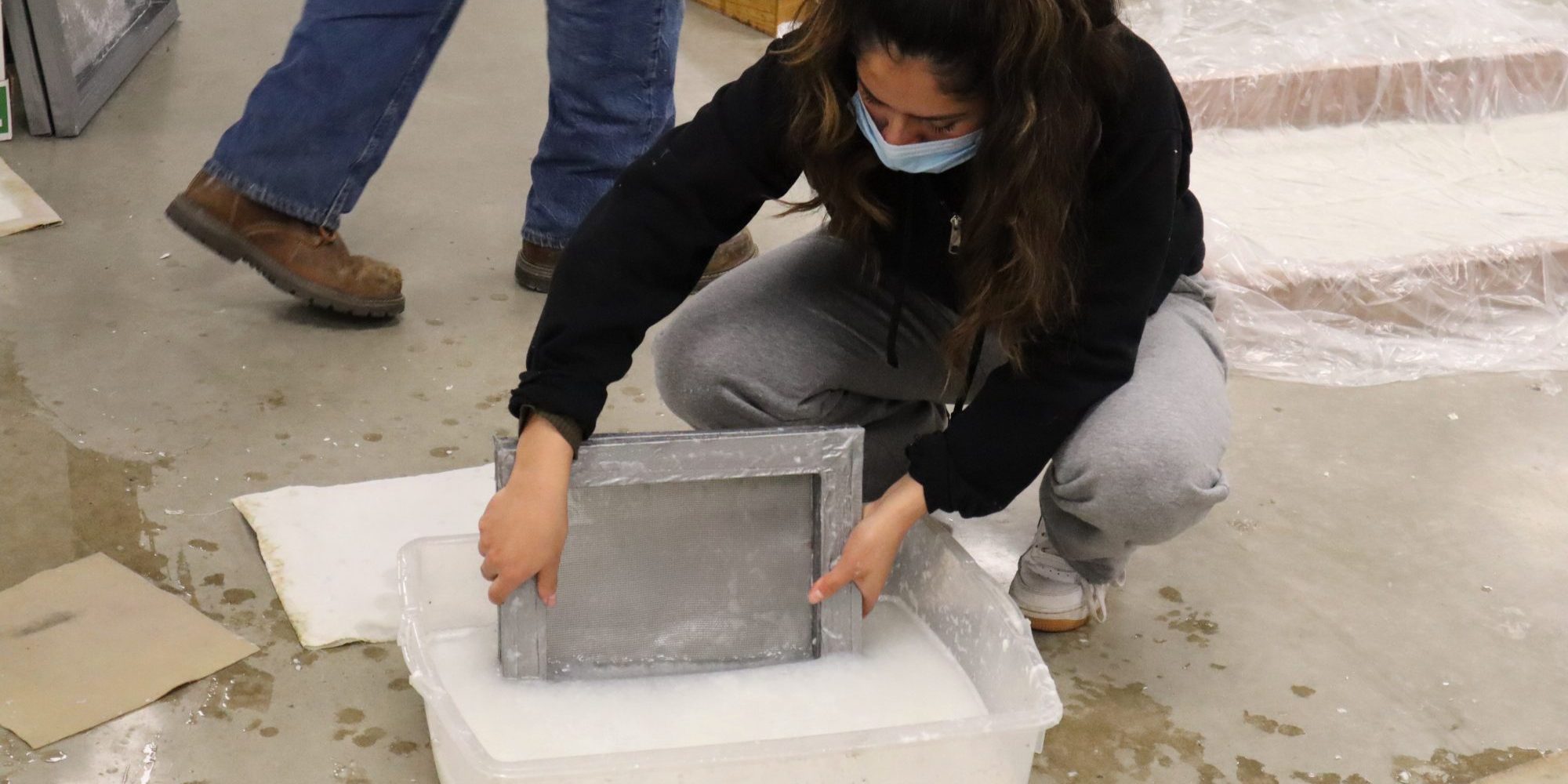
Art is far more than just making or performing. It creates context and meaning that serves as an extraordinary portal into science, culture and history. In this course, we’ll do paper-making as a way to explore the chemistry of hydrogen bonding. We’ll discuss quilting as an avenue into culture and identity. We’ll go as far back in time as we can, looking at the intersection of art-making, storytelling, carbon, and the physics of lightfastness. From there, you’ll have the opportunity to explore your own creative interests and how they can serve as an avenue leading to other disciplines and ideas.
________________________________
This course is drawn from nearly 40 years of work by the instructor, David Pyle, in the intersection of the arts, education, commerce, and chemistry. It’s based on the premise that the arts can metaphorically act as a "railroad roundhouse" allowing us to enter on the arts "track" and then, depending on how we rotate the turntable, we can exit on a chemistry track. Or physics. Or culture and history. Or any of a thousand disciplines.
During the first week, we’ll make paper by hand and use that as a track taking us to organic chemistry and hydrogen bonding. Next, we’ll discuss historical pigments and paint-making and crushed cochineal to make genuine carmine. From there, we’ll open a track to explore Aztec codices, history, and culture and then move into materials science.
We’ll explore the ideas around Temple Grandin’s most recent book, Visual Thinking, and her commitment to developing essential engineering skills through learning that comes from drawing and sewing and other arts.
The first ten weeks of the course feature an exploration of different intersections between the arts and science or culture. We’ll look at quilting and the Gee's Bend quilters as an intersection with history and community-building. We’ll explore intersections between painting, optics, and how pigments are being used in Biomedical Engineering. From there, we'll dive into the direct and powerful intersection between the work done by Josef Albers on the Interaction of Color which gives us a track to the Well-Tempered Clavier by J.S. Bach which opens a direct link with the Principle of Uncertainty by physicist Werner Heisenberg.
During the last five weeks of the course, the students will each present a unique intersection that they’ve explored.
Courses Taught
Gold
Green